
What size euro cylinder do I need?
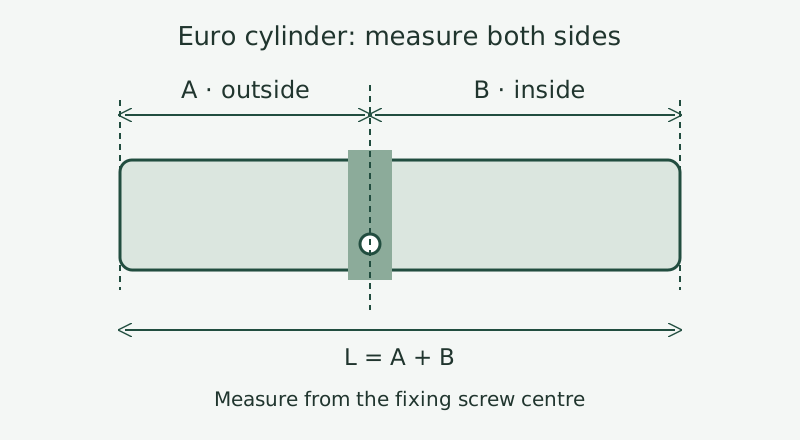
Measure two distances in millimetres: from the centre of the cylinder fixing screw to the outside end, then from the same centre to the inside end. Record both sides separately, for example “outside 30 mm / inside 40 mm”. Do not order from the total length alone.
This guide covers euro profile cylinders, commonly found in uPVC, composite and some timber doors. A euro cylinder has a rounded upper section and a narrower lower section. A round rim cylinder, threaded mortise cylinder or oval cylinder needs a different sizing method. Identify the profile before using the measurements below.
How to measure a euro cylinder without removing it
Open the door and keep it open while checking the hardware. Use a millimetre ruler and a small square to line up the measuring points; a tape measure can be awkward around projecting handles. Take a photo and label which side faces outdoors.
- Locate the cylinder fixing screw on the door edge, in line with the lower part of the cylinder. Use the centre of that screw as your reference, not the edge of the faceplate or the handle spindle.
- Measure from that centre line to the outside cylinder end. Also check the outer face of the handle backplate, escutcheon or cylinder guard: replacement sizing must suit the finished hardware.
- Measure from the same centre line to the inside end. Do not assume the fixing screw is halfway through the door.
- Write down outside and inside dimensions in millimetres. Mark the thumbturn side, if fitted, and check the selected product drawing before ordering.
Sources: [1]
Measuring a cylinder that is already out of the door
Lay the cylinder beside a ruler. Measure from the centre of its fixing-screw hole to each end of the cylinder body. Exclude the key and any projecting thumbturn knob. Keep the outside/inside orientation labelled: an asymmetric cylinder can look reversible while its specified functions are not.
The removed part tells you its existing dimensions, but it does not prove that it fitted correctly. Compare those dimensions with the door and the final handle plates or guard. If you are changing the furniture, the new cylinder may need different lengths. If the reference point is hidden or the cylinder will not come out normally, consult its fitting instructions or an installer rather than forcing it.
Sources: [2]
Euro cylinder size chart: what do 30/40 and 35/35 mean?
A split size describes two lengths from the fixing-screw centre. These examples explain the arithmetic; they are not a universal list of sizes offered by every manufacturer. In this guide A means outside and B means inside. Retailers may use a different order.
For example, replacing a 30/40 with a 35/35 moves 5 mm from the inside to the outside. Both are 70 mm long, but the outside fit changes. On a thumbturn model, write “thumbturn inside” as well as the measurements so the supplier can confirm the correct version.
| Outside A | Inside B | Total length |
|---|---|---|
| 30 | 30 | 60 |
| 30 | 40 | 70 |
| 35 | 35 | 70 |
| 40 | 30 | 70 |
| 35 | 45 | 80 |
Should a euro cylinder sit flush with the handle?
Avoid choosing a longer cylinder just to make the key easier to reach. Check the allowed projection against the instructions for the cylinder and its protective hardware. A cylinder guard may cover the end differently from a plain handle plate, so there is no single fit rule that replaces the selected hardware drawing.
Door thickness alone is not the ordering size. Handles, backplates and escutcheons add depth, and the lock case may sit off-centre. Measure the finished assembly on both sides, especially if you are replacing thick decorative handles with slimmer ones.
Sources: [2]
Before you buy a replacement cylinder
Dimensions are only part of the order. Use this checklist when comparing the existing cylinder with a replacement listing.
- Profile and drive: confirm euro profile and the required cam or gear arrangement.
- Outside / inside: record both lengths and match them to the supplier’s dimension drawing.
- Key / key or key / thumbturn: specify the internal thumbturn side explicitly.
- Functions: if you need operation with a key left on the other side, confirm that capability for the exact version.
- External protection: confirm which side has the specified security features and whether the cylinder suits your guard or handle set.
- Final check: follow the fitting instructions and test operation with the door open before closing it.
Sources: [2]
FAQ
Are all euro cylinder locks the same size?
No. Euro profile describes the profile, not one universal length. Measure each side from the fixing-screw centre and check the drive and functions too.
Can I use a 35/35 cylinder instead of a 30/40?
Not simply because both total 70 mm. One side becomes 5 mm longer and the other 5 mm shorter. Check the outside and inside fit separately.
Can I measure a lock cylinder without taking it out?
Usually, if you can identify the fixing-screw centre and the two end positions accurately. If a guard hides the reference points, use the product drawing or measure the removed part and check it against the door.
Which side is A on a thumbturn cylinder?
Here A means outside, but supplier conventions differ. Order using written outside and inside dimensions and state which side needs the thumbturn. Do not rely on A/B labels alone.
Related articles
Sources
- ABUS · Correctly measuring the door cylinder
Measurement from the fixing screw centre, including the fitted door furniture.
- CISA · Cylinder installation guide
Manufacturer guidance should be checked alongside the specific cylinder and door hardware instructions.
Manufacturer documents are provided in their original language.