
Scope: Based on the small-oval escutcheons, IRON guards and MULTIBLINDO/BLINDO modular guards in the ISEO catalogue; one series' capabilities are not extended to all escutcheons.
Specifications
- First check
- Cylinder hole profile and series
- Dimension checks
- Width, height, thickness, projection and fixing points
- Source scope
- ISEO Catalogue 01 .42, pages 201–205
Check coverage even when hole profiles match
The catalogue lists escutcheons for small-oval, Euro-profile and faceted round openings. Cover width alone does not make these profiles interchangeable. For example, the 83** series stainless steel escutcheon 042000 measures 18×48 mm, while nylon escutcheon 042001 measures 24×52 mm; both external coverage and thickness differ.
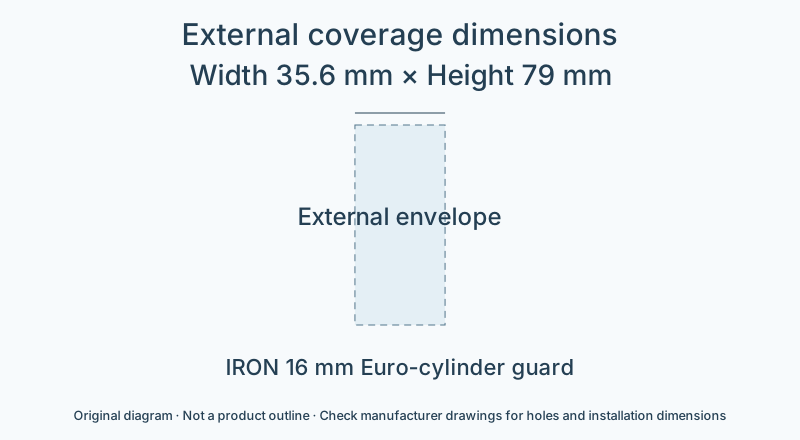
The width/height envelope allows preliminary comparison of door-face coverage, but does not provide all hole-position, chamfer and profile information and cannot serve as a drilling template.
Material names do not replace construction details
The ordinary escutcheon catalogue lists aluminium, brass, stainless steel and nylon. The IRON series explicitly lists hardened-steel guards and cylinder-projection ranges. These sources provide different levels of detail; harder material alone does not establish an equivalent protection grade.
Modular guard 040809 is intended for MULTIBLINDO and BLINDO. The catalogue also describes internal fixing, inner and outer aluminium escutcheons, a carbonitrided-steel outer plate and anti-drill device, plus spacers and screws. Its compatibility differs from that of a single-piece escutcheon.
Projection is not door thickness
The IRON L=16 mm version corresponds to cylinder projection of 4–11.2 mm; the L=12 mm version corresponds to 4–7.4 mm. This compares the cylinder's projection beyond the mounting surface, not total door thickness or cylinder length.
When purchasing, provide cylinder hole profile, projection, door-face conditions and existing fixing points together. The catalogue's permitted projection range must correspond to the actual guard version; being “all IRON” does not make every dimension interchangeable.
Sources
- ISEO · Catalogue 01 .42, PDF page 201
Product fields, interfaces and dimension drawings on this page; no performance is inferred for other models.
- ISEO · Catalogue 01 .42, PDF page 202
Product fields, interfaces and dimension drawings on this page; no performance is inferred for other models.
- ISEO · Catalogue 01 .42, PDF page 205
Product fields, interfaces and dimension drawings on this page; no performance is inferred for other models.
Manufacturer documents are provided in their original language.