
Scope: Uses the CISA RS5, AP4 and Astral padlock catalogues as examples; these models' key-removal conditions are not extended to all padlocks.
Specifications
- What to check
- Key-removal conditions in unlocked and locked states
- Catalogue wording
- Key removable in locked position only
- Distinct from
- Keyed-alike configuration, master-key systems or cylinder replaceability
What does “key removable only when locked” mean in the catalogue?
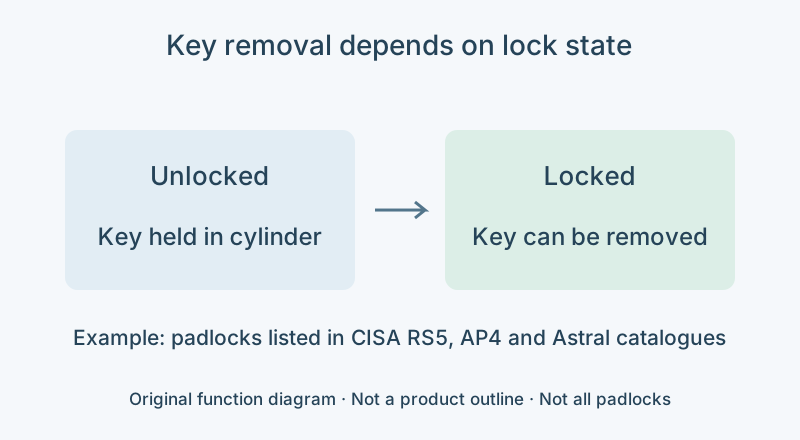
The CISA RS5 catalogue states that the key can be removed only when the shackle is closed; the AP4 and Astral pages say “key removable in locked position only”. This means the key normally remains in the cylinder when unlocked and should not be treated as an ordinary fault.
This function describes the lock's operating conditions. It does not independently prove that the shackle passes through the correct hasp, nor replace the user's check that the object being locked is secured.
Do not confuse it with keyed-alike or replaceable-cylinder features
Keyed-alike configuration concerns whether one key opens several locks; key retention concerns the state in which the key can be removed. Ask about them separately; a group of padlocks sharing a key does not establish that all retain the key when unlocked.
The Astral catalogue states both that the cylinder can be removed for rekeying or replacement and that the key is removable after locking. Both features can coexist, but “replaceable cylinder” alone does not specify when the key can be removed. Check replacement parts against the specific model and the manufacturer's service instructions.
Sources: [3]
How to specify the requirement when purchasing
State the requirement as “the key must not be removable in the normal unlocked state and must be removable after locking”, then ask the supplier to identify the corresponding model instructions. “With key”, “security key” or “removable key” does not make this condition explicit.
Also record the complete model, shackle clear width, clear height and diameter. Correct operation does not establish that the shackle passes through the existing hasp; conversely, dimensional compatibility does not establish key-removal conditions. If operation differs from the instructions, check shackle position and the correct key, then follow the manufacturer's maintenance instructions without forcing the key to turn or pull out.
Sources
- CISA · English catalogue: RS5 steel padlocks, PDF page 143
Key-removal conditions and cylinder information for this series; not extended to unlisted padlocks.
- CISA · English catalogue: AP4 steel padlocks, PDF page 144
Key-removal conditions and cylinder information for this series; not extended to unlisted padlocks.
- CISA · English catalogue: Astral steel padlocks, PDF page 147
Key-removal conditions and cylinder information for this series; not extended to unlisted padlocks.
Manufacturer documents are provided in their original language.